
Science & Technology21 November 20265 min read
Digital India BHASHINI Division demonstrates multilingual AI at Global Digital Health Summit 2026
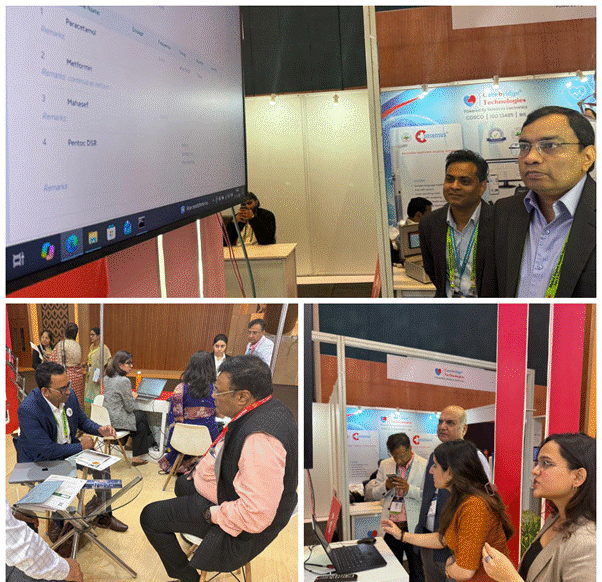
The Digital India BHASHINI Division (DIBD) demonstrated multilingual AI applications at the Global Digital Health Summit 2026 at Bharat Mandapam, New Delhi, on 20–21 November. The Division operates under the Digital India Corporation and the Ministry of Electronics and Information Technology.
The summit’s theme was “Implementing Artificial Intelligence – AI in Action”. BHASHINI’s demonstrations covered clinical documentation, communication between doctors and patients, and access to healthcare information in different languages.
How BHASHINI is being used in clinical workflows
Applications demonstrated by JIPMER, AIIMS and the Directorate General of Medical Services (Army) showed how language tools can be used in clinical work:
- Clinical documentation: Doctors can use speech-to-text and voice-based tools to record clinical histories, notes and discharge instructions.
- Doctor-patient communication: Speech technologies demonstrated how doctors and patients can communicate across languages.
- Prescription support: A speech-to-text facility integrated with the eHospital prescription module lets doctors dictate prescriptions.
JIPMER’s e-Sushrut integration
At the Jawaharlal Institute of Postgraduate Medical Education and Research (JIPMER), e-BHASHINI is integrated with JIPMER’s e-Sushrut Hospital Management Information System. It enables voice-based documentation of clinical histories, inpatient department (IPD) notes and discharge instructions.
Doctors can document information in English or supported Indian languages, including case histories for outpatient department (OPD) patients and notes from IPD rounds.
AIIMS demonstrations and eHospital prescriptions
At the All India Institute of Medical Sciences (AIIMS), demonstrations showed speech technologies being used to support conversations between doctors and patients who speak different languages.
BHASHINI’s speech-to-text facility has been integrated with NIC’s eHospital prescription module at the National Informatics Centre (NIC). Doctors can dictate prescriptions, saving time in busy OPDs. Doctors gave positive feedback on the application during a pilot in Neurology and Neurosurgery. It is being rolled out across AIIMS.
The Army’s i-Dhanwantri application
The Directorate General of Medical Services (Army) demonstrated BHASHINI technology in i-Dhanwantri, which converts doctors’ spoken clinical notes into typed text for medical documentation.
Maj Gen Sandeep Bhalla, ADGMS (IS, H & PS), said the Army’s medical services cover serving personnel, retired ex-servicemen and their families from different parts of India, who speak different languages. He said speech-to-text support can save doctors time, while language support can help patients explain their concerns and understand medical advice and prescriptions. The organisation intends to collaborate with BHASHINI and fine-tune the solution over time.
How community language data can improve health communication
BHASHINI presented community-led efforts to build medical language resources through:
- BhashaDaan for Health and Data Daan for Health: Community-driven efforts to build health-related language resources.
- Colloquial symptom data: Recording everyday expressions alongside medical terminology to help AI systems recognise how people describe health concerns.
- Granthika: A guided platform for collecting and digitising written and oral language resources.
BhashaDaan for Health and Data Daan for Health
Data Daan for Health aims to build multilingual healthcare datasets by recording colloquial expressions for symptoms and conditions alongside medical terms. For example, the Hindi expression “पैर में पानी भर गया है” can be mapped to “Oedema”.
Mapping regional and everyday expressions to standard medical terms is intended to help AI systems recognise how people describe health concerns and facilitate communication with healthcare professionals. BHASHINI also presented BhashaDaan for Health as a community-driven effort to strengthen medical language resources.
Granthika
Granthika supports the collection and digitisation of written and oral language resources. It was demonstrated as part of BHASHINI’s work to build language resources for healthcare.
What other multilingual tools were demonstrated
The exhibition also featured:
- The BHASHINI mobile application’s translation and voice capabilities.
- Shrutlekh, for real-time multilingual transcription and translation.
- An interactive AI-powered healthcare persona showing conversational, voice-enabled interactions.
- Demonstrations of multilingual conversations between doctors and patients.
Why BHASHINI sees language as part of digital healthcare
On the summit’s concluding day, Digital India BHASHINI Division CEO Amitabh Nag delivered a keynote on using AI to remove language barriers in healthcare. He described language as a critical but often overlooked layer of digital healthcare and said language intelligence should be integrated into digital infrastructure.
Nag said multilingual AI can help patients understand, communicate and access services in their preferred languages. It can also support communication between doctors and patients, simplify clinical documentation and improve access to medical information.
He said care communicated in a patient’s own language, whether Bodo, Marathi, Punjabi or Maithili, can foster familiarity, comfort, trust and a stronger connection with healthcare professionals.
The languages and services supported by BHASHINI
BHASHINI provides language services for integration into government and public-facing digital services. Its reported language coverage and usage include:
| Measure | BHASHINI support or usage |
|---|---|
| Indian text languages | 36 |
| Indian voice languages | 23 |
| International languages | 35 |
| Services | Translation, speech recognition, speech synthesis, transliteration and other language services |
| Recorded inferences | Over 11 billion, with approximately 24 million processed daily |